

Invasive predators can quickly decimate breeding colonies by eating eggs, chicks, and adult birds. One pregnant female brown rat can produce a population of 300 individuals in around eight months. It is vital that we stop them reaching these important islands
Welsh islands are globally important for breeding seabirds. As frequenters of Wales’ coastline, you know how fortunate we are to be surrounded by such varied, and biodiverse landscapes. The small islands dotted off our coast and the amazing wildlife that calls them home are the jewel in the crown.
Have you ever wondered why these islands attract so many seabirds? While seabirds are perfectly adapted to a life at sea, on land they are clumsy and vulnerable. To reduce the risk of predation from their natural predators (those which have evolved alongside each other in the same habitats) some species, such as Manx Shearwater, only return to land under cover of darkness when the gulls and skuas who pose them the greatest predatory threat, are less active. Others have evolved to nest in dense colonies taking advantage of ‘safety in numbers’ to protect their eggs and chicks. However, these evolved defences are useless against mammalian predators which can follow birds into their burrows and are agile enough to clamber about on cliffs. These islands are havens for seabirds because of the absence of mammalian predators such as rats, cats, stoats, hedgehogs and mink.
Wales’ responsibility for the fate of UK seabirds has never been greater, as while globally and nationally, many seabird populations have been declining, Wales, in several cases has been bucking this trend (prior to the current avian flu outbreak).
SSSI (site of special scientific interest) for seabirds. Having such important numbers of seabirds concentrated on a small number of islands makes their populations especially vulnerable. Wales’ seabird islands pulsate with life yet these precious offshore sanctuaries face a silent threat: invasive predators like rats. Rats have arrived on many seabird islands due to human activity, largely the transport of cargo, or through shipwrecks. This occurred on Ramsey Island, with rats arriving via shipwrecks in the 1800s. Puffins were soon wiped out on the island, and while manxies remained, they were unable to raise any chicks, and are thought to have only endured due to the continual topping-up of birds from Skomer and Skokholm islands, whose populations were expanding. In the 1990s, the RSPB Ramsey Island team embarked on a programme to remove rats from the island. The results of the eradication programme were remarkable, with Manx Shearwater numbers rocketing from a few hundred to 6,225 pairs in just a few years.
The impacts of rats on seabird islands can be long-lasting. Puffins are incredibly social and loyal birds, with adults returning to the same colony (sometimes even the same burrow) to breed each year,
and youngsters visiting existing colonies to find mates and burrows. This means they are incredibly slow to (re)establish sites, preferring to grow existing colonies. Despite the good habitat and efforts from the island wardens, puffins have yet to return to breed on Ramsey.
Shipwrecks are less common than they used to be, but accidental boat groundings still occur regularly, for example the lifeboat from a tanker which was lost during a routine exercise in May this year.
From a wildlife perspective, preventing rats from establishing on an island is far better than attempting to eradicate them once established. This is also true from a human perspective, as the resources required to complete an effective eradication are many times greater than what is required to prevent arrivals. Recent projects to eradicate rats from seabird islands around the UK have cost around £1,000,000 per site. Eradications take years to plan and seabird numbers continue declining between discovering that rats have colonised and beginning an eradication. Eradications are not always successful. If an invasive predator reaches a seabird island, we need an early warning system and routine surveillance on islands, as they tend to maintain a low profile until the population has grown substantially. We have several methods of surveillance, including trail cameras and chew marks, but none are 100% reliable as they are “passive”, relying on the behaviour of the animal to enable detection.
JINX
We also have a conservation detection dog called Jinx. Jinx’s nose has up to 300 million olfactory receptors – compared to a measly six million in humans and the area of his brain dedicated to analysing smells is around 40 times greater than ours. All of this means that he has an amazing sense of smell and can smell things that we can’t. He can pick out and locate the smell of a single rat or dropping amongst all the other smells on an island. He does not catch or kill rats, his job is to indicate the presence of a rat so that we can implement an incursion response. Conservation detection dogs are used worldwide and are growing in popularity for noninvasive monitoring of sensitive or cryptic species.
Jinx and his handler Greg head out to islands to check that no rats have snuck passed our other biosecurity measures, they can also check boats before they sail over to the islands to make sure that they aren’t carrying any rats. Jinx is currently our only ‘active’ method of detecting rats. Over the past year, Greg and Jinx have carried out routine biosecurity checks on Flat holm, The Skerries, Caldey, Ramsey, Skokholm and Skomer. They also took part in an incursion response on Skokholm following the grounding of an oil tanker’s lifeboat on the island. In all cases the islands received a clean bill of health, and no signs of rats were detected. They have also been busy checking boats and cargo before they leave mainland to head over to the islands to ensure that there are no stowaways on board.
Sea Birds Need Help
Seabirds are under pressure from many threats including:
» Highly Pathogenic Avian Influenza (bird flu)
» Climate change
» Accidental bycatch (being caught accidentally by fishing
practices)
» Invasive non-native species
» Lack of food due to overfishing
» Offshore renewable energy infrastructure
Many of these pressures are human generated and we have a responsibility to alleviate what pressures we can. Highly Pathogenic Avian Influenza (bird flu) is an additional threat to seabirds. Bird flu has had a devastating impact on seabirds, causing the number of gannets nesting on Grassholm to plummet by a massive 52%, from 34,491 in 2022 to 16,482 in 2023. Bird flu has not replaced the other pressures that seabirds were already facing. Alleviating pressures has never been more important for the surviving populations to stand a chance of recovering. Seabirds are long lived, slow to reach breeding age and many species only rear a maximum of one chick each year.
This means that when adults die in large numbers the populations cannot breed fast enough to make up for the losses and species go into steep declines. If an invasive predator is found on a seabird island, a rapid response is critical. Two regional Rapid Incursion Response Hubs have been established in Wales which contain everything required for responding to an incursion. To operate these hubs, we are training teams of volunteers. If you would like to find out more about being a part of our incursion response team head to our website.
Biosecurity is integral to ensuring that surviving adults have a safe place to rear their young. To stand a chance in a changing world, seabirds require their breeding grounds to remain free from predatory mammals.
How Can You Help
Anyone travelling to a seabird island or in the vicinity of a protected seabird island has a responsibility to undertake basic checks before setting off and implement biosecurity measures.
Always check, clean, dry. Never land on an island without permission. If you have found signs of a stowaway onboard your kayak, do not land on a rat-free island. Never push a stowaway overboard,
most mammals are strong swimmers – brown rats can swim up to 4km! Never assume that there was only one stowaway aboard. You should return to mainland and check all boats and bags.
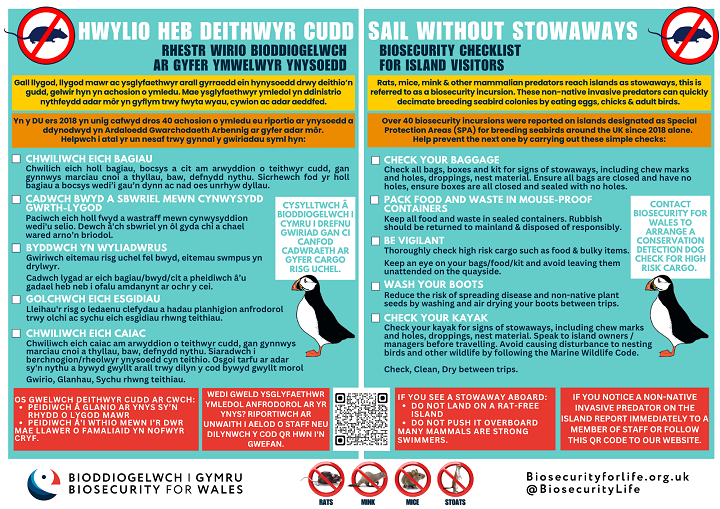
Use the checklist below next time you head over to an island.
If you would like a kayak sticker to remind yourself and others of the importance of biosecurity, send us an email in the 'contact us' section of the website!
MORE INFO for stacks of useful information on biosecurity including advice, guides and posters, plus stickers for your paddlecraft visit: www.biosecurityforlife.org.uk
CONTACT THE MEDIA TEAM
If you have a story that would be of interest to the Paddle Cymru team please get in touch using the online contact form linked below or get in contact using one of our social feeds.
SIGN UP TO CEUFAD MAGAZINE
Ceufad is our quarterly magazine, covering everything that's important in Welsh paddlesport.
Share Post